Atharva A Baldota
Entry-level software engineer with a Computer Science foundation, eager to learn from an experienced team. I have taken one independent project from concept to deployment.
About
I am a Computer Science graduate (Savitribai Phule Pune University, 2023) and have completed a postgraduate program in Generative AI and Machine Learning. I am looking for an entry-level software engineering role on an established team, where I can learn from senior engineers, take on real work and grow quickly.
To learn how software is built end to end, I took the initiative on an independent personal project: VittaFide, an offline-first billing and Khata app for small shops, now live on Indus Appstore. Working on my own, I researched technology options, wrote the requirements, planned the user workflows, built the app through AI-assisted development and tested it on real devices. It showed me how each stage connects, from an idea to released software.
I am curious about how things work, not just whether they work. I ask questions early, act on feedback and put in the hours to get the details right. I want to bring that to a team where I can keep learning from people who do this well.
How I work
Skills I practised hands-on while building VittaFide on my own, and want to keep developing within a professional team.
- Technology research and solution exploration
- Comparing options and trade-offs before choosing an approach.
- Requirements analysis and feature planning
- Turning a broad idea into clear, scoped requirements.
- User workflow planning
- Mapping how a user moves through a task step by step, such as making a bill or recording a part payment.
- AI-assisted problem-solving
- Using AI to explore a problem faster, then checking the result myself.
- Prompt design and iterative refinement
- Writing clear instructions and improving them over several rounds.
- AI-assisted code generation and review
- Generating code with AI assistance and reviewing the output before accepting it.
- Technical issue investigation and debugging
- Narrowing down what is going wrong and confirming that the fix works.
- Edge-case analysis and software testing
- Testing against limits and unusual inputs, such as stock shortfalls, over-payments and returns, on real devices.
- Git and GitHub for version control
- Keeping a tracked history of changes.
- Continuous learning
- Completed a postgraduate program in Generative AI and Machine Learning in 2026, and keep learning through hands-on work.
Featured project
VittaFide: Billing & Khata
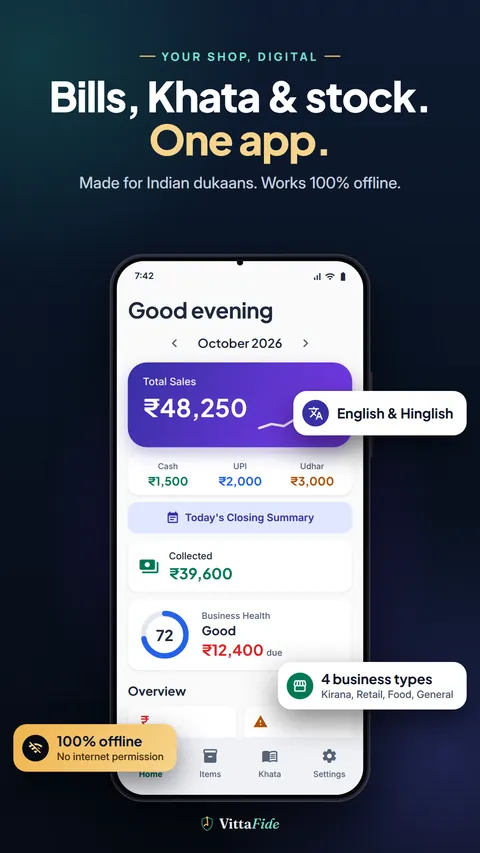
An offline-first Android app for small Indian shops. It brings billing, a digital customer credit ledger (the Khata, a shopkeeper's record of udhar, or credit) and stock tracking into one app.
- Platform
- Android
- Version
- v2.3.0
- Availability
- Live on Indus Appstore
- Shop types
- Kirana, Retail, Food & Cafe, General
- Source code
- Private repository
Built around three principles
Offline-first
Every feature works with no connection: billing, Khata, stock, insights and even barcode scanning, with the scanner model built into the app. No account and no sign-up.
Zero-cloud privacy
No internet permission, no cloud, no ads and no analytics. Shop data stays on the phone unless the shopkeeper chooses to send it.
Encrypted on the device
An encrypted database whose key sits in the phone's secure hardware where available, behind a PIN or fingerprint lock. The PIN is stored only as a one-way hash.
What I did
- Researched technology options for an app that works entirely offline.
- Defined the requirements and planned features and user workflows for billing, Khata, payment collection, stock, insights and backups.
- Worked through the business logic: bill calculation, partial payments against customer dues and the payment-reliability score.
- Investigated and debugged technical issues, confirming each fix on a real device.
- Tested edge cases such as stock limits, over-payments and returns on physical Android devices.
- Released the app on Indus Appstore; the Google Play listing is under review.
How it was built
VittaFide is an independent project I worked on by myself to learn how software goes from concept to deployment. I used an AI-assisted workflow: I wrote the requirements, wrote and refined the prompts, reviewed the output and tested its behaviour on real devices. The research, planning and testing were my own work, and AI assistance helped write the code. Working this way taught me to check generated code carefully rather than take it on trust.
Product walkthrough
App screens
Tap any screen to enlarge it. Screens show sample shop and customer data.
What the app does
The v2.3.0 feature set at a glance.
| Area | What it does |
|---|---|
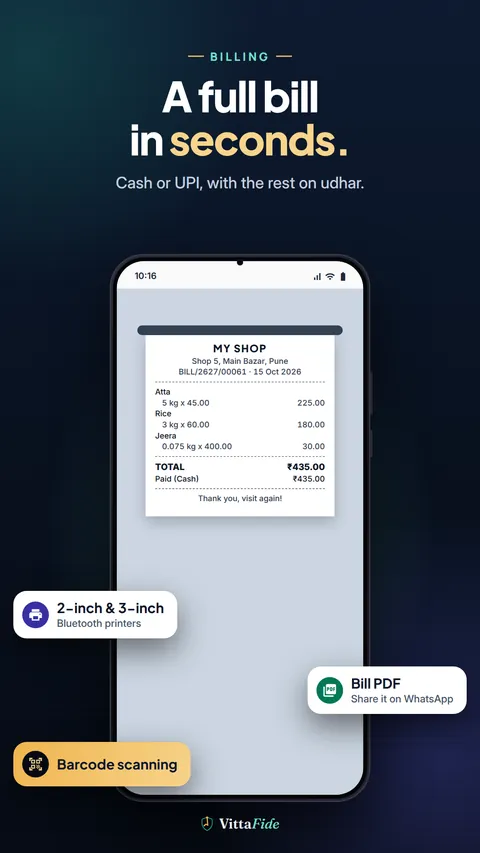
| Billing | Itemised bills paid in cash or UPI, with any balance recorded as udhar. Bills can be shared as a PDF on WhatsApp or printed on a 2‑inch or 3‑inch Bluetooth thermal printer. |
| Sell by amount | In Kirana mode, for loose goods sold by weight or volume, the shopkeeper types the amount the customer pays and the app works out the quantity. |
| Barcode scanning | Camera scanning that fills in the item, price and unit, and links new barcodes to products. It works fully offline. |
| Digital Khata | A ledger for each customer. Payments clear the oldest dues first. It can share a PDF statement and send a WhatsApp payment reminder. |
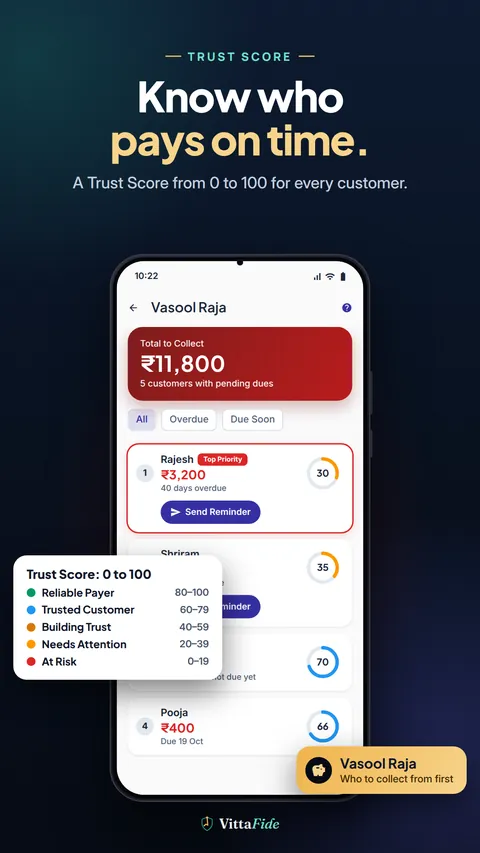
| Trust Score and Vasool Raja | A 0 to 100 score for each customer, worked out on the phone from their payment history, and a list that ranks whom to chase first. |
| Shop types | At setup a shop picks Kirana, Retail, Food & Cafe or General. The choice changes the screens and shortcuts, for example tables and takeaway tokens for Food & Cafe. |
| Stock and alerts | Optional stock counting, restock and damage records, packs such as Box, and low-stock and expiry alerts. Stock that expires first is sold first. |
| Apna CA | Insights calculated on the phone: a business health score, a seven-day cash flow forecast, spending breakdown and plain-language advice. |
| Returns, held bills and expenses | Take items back from a saved bill and refund the customer, hold a half-finished bill for later, and record shop expenses. |
| Privacy and backups | No internet permission, an encrypted on-device database and a PIN or fingerprint lock. A device backup is made nightly and kept for 7 days, and a portable backup moves data to a new phone. |
Education
| Period | Programme | Status |
|---|---|---|
| Jan 2026 to Oct 2026 | Postgraduate Program in Generative AI & Machine LearningEdureka | Completed |
| Graduated 2023 | Bachelor of Computer ScienceSavitribai Phule Pune University | Graduated |
Contact
Hiring for an entry-level or associate software engineering role? I would be glad to talk.